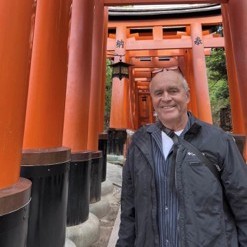
I have been the venture lead in the chair you are sitting in.
That is not a positioning statement. It is the reason this firm exists.
I did not set out to build a diagnostic firm. I set out to build businesses.
I joined Intel out of Pepperdine's MBA program and spent the next twenty-three years there. What those years became — without my planning it that way — was a graduate education in exactly how corporate ventures succeed, how they fail, and why the failure is almost never about the quality of the idea.
The Intel Capital Years (2000–2007)
My first role at Intel was in venture equity investing at Intel Capital. Over seven years I managed ten early- and mid-stage equity investments totaling $55M with a 9% IRR.
What Intel Capital taught me was how to read a bet — not just the idea, but the organizational structure around it, the market timing, the unit economics, the gap between what a team believes and what the evidence actually supports. It taught me to ask uncomfortable questions before capital committed rather than after.
The Incubation Years (2007–2017)
In 2007 I moved from investing into building. For the next decade I ran Intel's new business startup function — raising internal capital and incubating ventures across logistics, pharma analytics, fintech, and AI. I raised $15M+ for internal startups. I built businesses from nothing. I found positions in iZettle, CashStar, and SecureKey. Those three investments alone generated over $200M in strategic value for Intel.
Some of what I built worked. A fintech ecosystem play I structured as a financial services partnership — rather than forcing it through Intel's semiconductor-focused operating model — generated $10M+ in annual revenue in its first commercialization year and contributed to $200M+ in strategic equity value through targeted investments in the financial ecosystem. The idea was right. The organizational host configuration was wrong. Restructuring around a partnership rather than internal incubation made the difference.
Some of what I built did not work. And one failure in particular is the reason THC Consulting exists.
The Mistake That Built the Methodology
I once spent six months defending a logistics analytics venture before I understood something that an honest structural read in week two would have surfaced immediately: Intel's salesforce was built to sell silicon on quarterly hardware cycles. The venture needed multi-year, relationship-intensive service contracts. The compensation model was wrong. The deal cycle was wrong. The reporting infrastructure was wrong.
The idea was right. The host was wrong.
I kept rationalizing the gaps. I kept telling myself the salesforce would adapt, that executive sponsorship would carry the weight, that the organizational gaps would close with enough momentum. They did not close. They could not close. The math was not a culture problem.
What I did not have was a structured framework that forced me to answer the hard organizational questions honestly before I had spent six months and significant political capital finding out the expensive way. That framework is what THC now uses in every sprint.
The AI Years (2017–2018)
From 2017 to 2018 I led channel sales, product strategy, and AI Ethics for Intel's Saffron Technology acquisition — a cognitive AI platform positioned in financial services and supply chain. I built the AI business CLV and financial modeling framework that informed Intel's global go-to-market strategy for the product. I also led a cross-functional taskforce to embed ethical principles into the AI product design and development lifecycle — work that turned out to be five years ahead of where the industry's attention eventually landed.
What that period taught me was the specific failure modes of AI-augmented analysis — where the tools amplify optimism bias rather than correcting it, and where a human with domain judgment has to override what the model is telling them. Those lessons are built into the Black Box Bias Audit that THC runs in every engagement.
Why THC Exists
I left Intel and founded THC Consulting because the problem I had spent twenty-three years watching up close — corporate ventures failing not because of bad ideas but because of late-stage pivots made after capital, headcount, and political will were already committed — had not been solved by anyone operating at the price point and with the methodology that mid-market companies actually needed.
The gap in the middle — senior, verdict-producing, capital-allocation-framed, AI-leveraged, mid-market-priced — was the space I had been trained for without knowing it. The Venture Architecture Diagnostic™ is the structured process I wish I'd had in the chair.
How THC Works
Every sprint is led personally by Thomas Calvert, end to end. No junior analysts. No delegated delivery. The senior principal is the product — and that is not a marketing claim, it is a structural commitment that shapes every engagement from scoping call through Day 14 verdict delivery.
The VAD runs on a structured AI toolkit — six purpose-built tools deployed across every analytical stream. The AI handles the analytical volume: live market research, assumption extraction, adversarial probing, financial modeling, and pattern matching across 128 catalogued cases. Thomas provides what the AI cannot: structural judgment, stakeholder reads, and the verdict.
The methodology runs on three integrated pillars. First: the Resources-Processes-Priorities structural diagnostic — grounded in Harvard Business School research and Christensen and Raynor's empirical work on disruptive innovation — which determines whether the organizational host can actually execute what the venture requires. Second: a proprietary Black Box Bias Audit — five adversarial techniques that surface the optimism biases internal teams structurally cannot see. Third: a six-tool AI toolkit that executes the analytical work at a depth and speed no analyst team replicates at this price point — every output reviewed and synthesized by Thomas personally. Behind all three is a Pattern Library of 128 catalogued venture cases that calibrates every scoring decision and every market estimate the sprint produces.
The verdict is one of four: GO, PIVOT, WRONG COMPANY, or NO-GO. Every verdict comes with a forward path. And THC stays in the room to help you carry that verdict to the people who need to act on it.
Thomas H. Calvert — Managing Director, THC Consulting
| Education | MBA, Pepperdine University (Graziadio) | BA Organizational Psychology, University of Michigan |
| Intel Capital | 2000–2007 | 10 investments | $55M managed |
| Intel New Business Startups | 2007–2017 | $15M+ raised for internal startups | iZettle, CashStar, SecureKey | $200M+ strategic value | Logistics, Pharma Analytics, Fintech, AI |
| Intel AI / Saffron | 2017–2018 | AI Ethics | CLV framework | Global channel strategy |
| Intel TSN & Business Incubation | 2018–2023 | Industrial ecosystem | Siemens, Phoenix Contact | New venture ideation |
| THC Consulting | 2023–Present | Founder & Managing Director | Creator of the Venture Architecture Diagnostic™ (VAD) | 8 analytical streams |
If you are defending an idea right now, this is the conversation worth having.
Not a pitch. Not a framework presentation. A direct conversation about your venture, where it sits, and whether a structured external verdict is the right next step.